
Falls are one of the most serious health risks facing older Australians. Every year, one in three people aged 65 and over will experience a fall — and for many, a single fall can lead to hospitalisation, loss of independence, and a significant decline in quality of life. The good news is that falls are …
Falls are one of the most serious health risks facing older Australians. Every year, one in three people aged 65 and over will experience a fall — and for many, a single fall can lead to hospitalisation, loss of independence, and a significant decline in quality of life.
The good news is that falls are largely preventable. With the right physiotherapy program, older adults can build the strength, balance, and confidence they need to move safely at home and in the community.
At Bayside Mobile Physio, we provide mobile falls prevention programs across Sydney — coming directly to your home to assess your environment and deliver a program tailored to your needs.
Why Do Older Adults Fall?
Falls in older adults are rarely caused by a single factor. Most falls result from a combination of physical, environmental, and medical contributors, including:
- Reduced muscle strength, particularly in the legs and core
- Poor balance and coordination
- Gait abnormalities — changes in the way a person walks
- Reduced sensation in the feet
- Vision impairment
- Medications that cause dizziness or low blood pressure
- Cognitive decline and reduced attention
- Home hazards — loose rugs, poor lighting, slippery floors, no grab rails
- Fear of falling — which paradoxically increases fall risk by causing people to move less
- Previous falls — having fallen once significantly increases the risk of falling again
A physiotherapy assessment looks at all of these factors together and identifies the specific contributors most relevant to your situation.
The Consequences of Falls in Older Adults
Falls can have serious physical and psychological consequences, including:
- Fractures — particularly hip, wrist, and vertebral fractures
- Head injuries and acquired brain injury
- Hospitalisation and extended recovery periods
- Loss of confidence and fear of falling
- Reduced activity levels leading to further deconditioning
- Loss of independence and entry into residential aged care
Hip fractures are among the most serious consequences — approximately 20 to 30 percent of older adults who sustain a hip fracture do not return to their prior level of function. This is why prevention is so much more effective than treatment.
How Physiotherapy Prevents Falls
Physiotherapy is one of the most evidence-based interventions for falls prevention. A physiotherapist addresses the physical factors that contribute to falls through targeted exercise, education, and environmental assessment.
Balance Training
Balance is a skill that can be trained and improved at any age. Balance exercises challenge your body’s stability systems in a controlled, progressive way — helping you react quickly and safely when you lose your footing.
Strength Training
Leg and core strength are critical for fall prevention. Stronger muscles mean better control of movement, faster reactions to a trip or slip, and greater ability to recover before a fall occurs.
Gait Retraining
Many older adults develop changes in their walking pattern — shorter steps, shuffling, reduced arm swing — that increase fall risk. A physiotherapist can identify and correct these patterns through targeted gait retraining exercises.
Home Hazard Assessment
Because we come to your home, we can assess your actual living environment for fall hazards — loose rugs, poor lighting, bathroom safety, step heights, and furniture placement. We can recommend modifications and refer for equipment such as grab rails, non-slip matting, and shower chairs.
Walking Aid Assessment and Training
If you need a walking aid — such as a walking frame, quad stick, or cane — a physiotherapist will assess which aid is most appropriate and ensure you are using it correctly and safely.
Medication Review Referral
We work alongside your GP and other health professionals to flag medications that may be contributing to dizziness, low blood pressure, or sedation — all of which increase fall risk.
Best Exercises for Falls Prevention
The following exercises are commonly included in physiotherapy-led falls prevention programs. Always consult your physiotherapist before starting a new exercise program.
1. Sit to Stand
One of the most functional exercises for fall prevention. Stand up from a chair and sit back down with control. Aim for 10 repetitions, working toward removing the use of armrests over time.
2. Heel Raises
Stand behind a sturdy chair for support. Slowly rise up onto your toes, hold for 2 seconds, then lower back down. Perform 15 repetitions. This strengthens the calf muscles which are critical for balance reactions.
3. Single Leg Stand
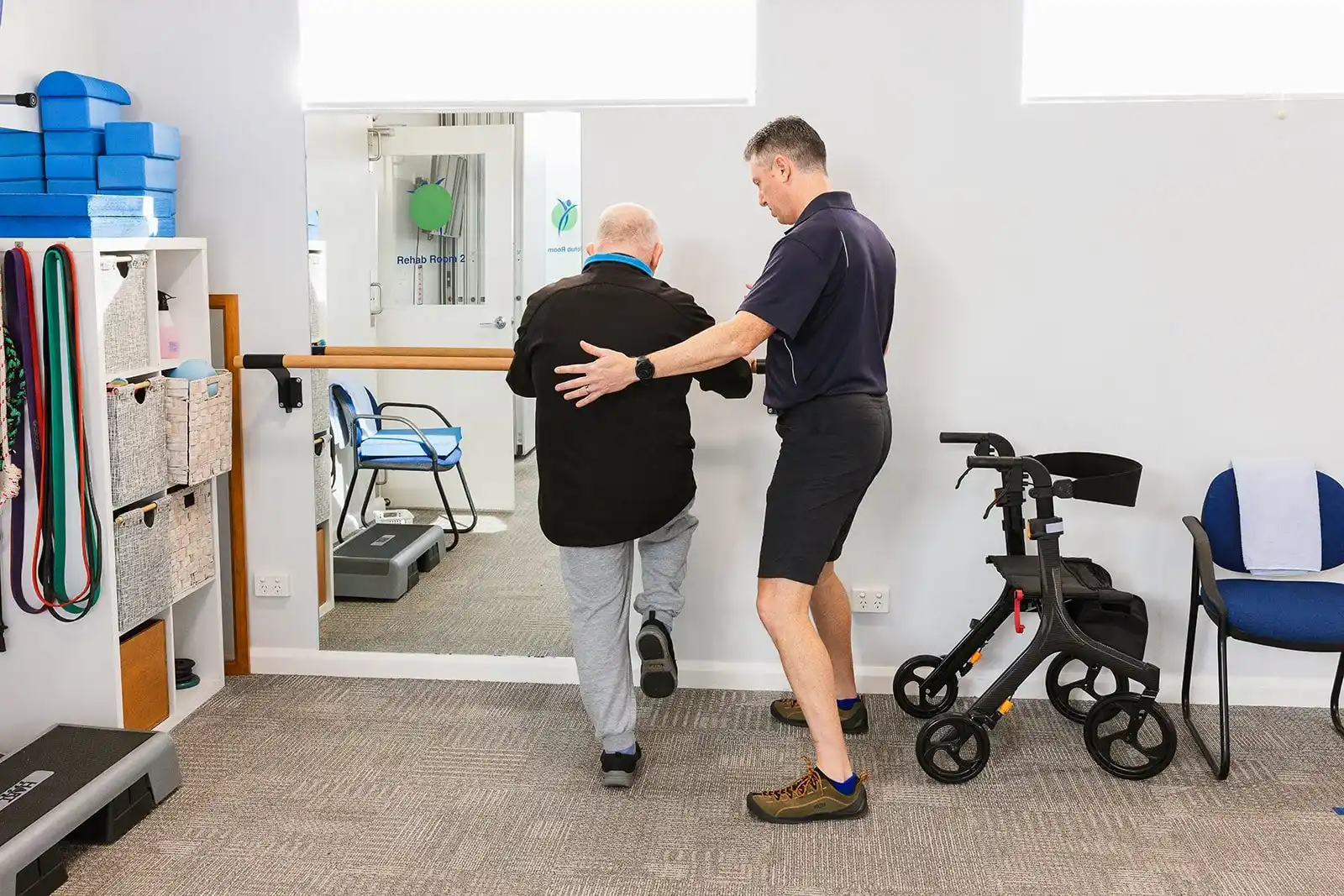
Stand on one leg for up to 30 seconds, using a bench or wall for support if needed. Alternate legs. This directly challenges your balance system and builds the stability needed to recover from a trip.
4. Tandem Standing and Walking
Stand with one foot directly in front of the other — heel to toe — and hold for 10 seconds. Progress to walking in a straight line in tandem fashion. This challenges balance in a functional, real-world way.
5. Sideways Walking
Step sideways along a hallway, crossing one foot in front of the other and then behind. Perform 10 steps in each direction. This improves lateral stability and prepares you for unexpected movements.
6. Backward Walking
Walk slowly backwards in a safe, clear space using a wall for guidance. This challenges balance and coordination in a way that forward walking does not.
7. Stepping Practice
Practice stepping up and down a single step, focusing on control and confidence. This directly prepares you for navigating steps and kerbs safely in daily life.
8. Leg Strengthening Exercises
Exercises such as squats, leg press, and seated leg extensions build the lower limb strength needed to react quickly and recover balance. Your physiotherapist will determine the right level of resistance for your current strength.
Falls Prevention Programs Under Aged Care Funding
Falls prevention physiotherapy can be funded through a number of programs for eligible older Australians:
- Home Care Package (HCP): Physiotherapy is an approved service under all levels of Home Care Package funding. Falls prevention is one of the most common reasons for physiotherapy referral under HCP.
- Support at Home program: The Support at Home program, which replaced the Home Care Package program, also funds physiotherapy services including falls prevention.
- NDIS: For eligible participants under 65, falls prevention physiotherapy can be funded under Capacity Building — Improved Daily Living.
- DVA: Department of Veterans’ Affairs card holders may be eligible for funded physiotherapy services.
- Private: Falls prevention physiotherapy is also available as a private service, with potential rebates through private health insurance.
Why Mobile Physiotherapy Is Ideal for Falls Prevention
There are significant advantages to receiving your falls prevention program at home rather than in a clinic:
- Your physiotherapist can assess your actual home environment and identify specific hazards
- Exercises can be practised in the spaces where falls are most likely to occur — the bathroom, kitchen, hallway, and garden
- No need to travel to a clinic, which can itself be a fall risk for frail older adults
- Family members and carers can be involved in the session to understand the program and support safe practice at home
Get Started With a Falls Prevention Program
If you or a loved one has had a fall, is at risk of falling, or simply wants to move more safely and confidently at home, Bayside Mobile Physio is here to help. We come to you across Sydney and respond to all enquiries within 2 business hours.
- Phone: 0468 079 075
- Email: [email protected]
Support coordinators, care managers, and health professionals can refer clients via our Make a Referral page.
Frequently Asked Questions
At what age should someone start a falls prevention program?
Falls prevention is most commonly recommended from age 65 onwards, or earlier if there are known risk factors such as a history of falls, balance problems, neurological conditions, or significant medication use. The earlier you start, the better — it is far easier to maintain strength and balance than to rebuild it after a fall.
How long does a falls prevention program take?
Most falls prevention programs run for 8 to 12 weeks with weekly or fortnightly physiotherapy sessions, supported by a daily home exercise program. Ongoing maintenance sessions are often recommended to sustain gains over the long term.
My parent has already had a fall — is it too late?
It is never too late. In fact, having experienced a fall is one of the strongest reasons to start a falls prevention program. Post-fall rehabilitation addresses both the physical risk factors and the fear of falling, which is a significant contributor to future fall risk.
Can falls prevention physiotherapy help someone with dementia?
Yes, with appropriate adaptation. People with dementia are at significantly higher fall risk due to cognitive, sensory, and medication-related factors. Physiotherapy programs for people with dementia focus on simplified exercises, safe movement habits, and environmental modification, often involving carers and family members in the delivery.
Bayside Mobile Physio provides mobile physiotherapy across Sydney specialising in aged care, NDIS, and private clients. For falls prevention enquiries call 0468 079 075 or email [email protected].

Daniel Chong, BPhty (Australian Catholic University), is an AHPRA-registered physiotherapist and the founder of Bayside Mobile Physio.