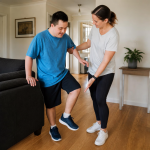

If you’re self-managing your NDIS plan and looking for a physiotherapist, the process is more flexible than most people realise, and it isn’t always explained clearly. This guide walks through exactly how self-managed NDIS physiotherapy works: who you can see, what it costs, how payment actually happens, and what to look for in a provider, with a focus on mobile (in-home) physio in Sydney.
What does “self-managed” mean for physiotherapy?
If your NDIS plan is self-managed, you handle the funding yourself rather than a plan manager or the NDIA paying providers on your behalf. In practice, that means you:
- Choose your own physiotherapist or provider
- Pay their invoice yourself after each session
- Claim the cost back from your plan through the myplace participant portal
This is different from plan-managed (a plan manager pays providers for you from your funding) and NDIA-managed (the NDIA pays providers directly). Self-managed and plan-managed participants both have significant flexibility in who they can see, more than most people realise.
Can I use an unregistered physiotherapist?
If you’re self-managed, you are not restricted to providers registered with the NDIS Quality and Safeguards Commission. You can choose any qualified, appropriately insured physiotherapist, registered or not, and plan-managed participants generally have the same freedom (see How to Find and Choose a Provider, NDIS).
Do need a referral?
No. You don’t need a GP referral, or a referral from your support coordinator, to start physiotherapy under your NDIS plan. You can self-refer directly to a provider, or ask your support coordinator to help you find one if you’d prefer that support.
What does physiotherapy get funded under?
Physiotherapy is typically funded through Capacity Building, Improved Daily Living, sometimes alongside Improved Health and Wellbeing depending on your plan’s goals (more on this in How NDIS Funds Physiotherapy). It isn’t limited to injury recovery; it commonly covers:
- Building strength, balance, and mobility
- Falls prevention
- Transfers (bed, chair, car) and manual handling
- Post-surgery or post-hospital rehabilitation
- Practising specific daily tasks safely, like getting in and out of the shower
- Wheelchair and seating assessments, and other assistive technology needs
How does invoicing and payment actually work?
The process depends on how your plan is managed:
- Plan-managed: we invoice your plan manager directly. There’s no paperwork for you to handle.
- Self-managed: you receive an invoice to pay within 14 days, then log into the myplace portal and enter the invoice details against the right support category to claim the amount back from your plan.
Fees are billed in accordance with the NDIS Pricing Arrangements and Price Limits, which set the maximum hourly rate a provider can charge and claim against most support categories. For eligible participants, that typically means no out-of-pocket cost. Rates are reviewed annually, so it’s worth confirming the current figure with your provider before booking.
Why a mobile (in-home) physiotherapist is worth considering
A clinic visit means transport, waiting rooms, and often help just getting there, all real barriers for a lot of NDIS participants and their families. A mobile physiotherapist comes to you instead, and there’s a genuine clinical upside beyond convenience: practising a transfer, a walk to the letterbox, or a shower routine in the actual home you live in tends to translate into daily life far more directly than the same exercise done in a clinic gym. We cover this in more depth in The Role of Physiotherapists in the NDIS.
Bayside Mobile Physio: in-home NDIS physiotherapy across Sydney
Bayside Mobile Physio provides in-home physiotherapy across greater Sydney, including Parramatta, Penrith, Bankstown, and the Eastern Suburbs, along with Liverpool, Campbelltown, Macarthur, Sutherland, the Inner West, St George, North Sydney, Ryde, Canada Bay, Fairfield, Blacktown, Hawkesbury, the Hills District, and the Northern Beaches.
We work with both self-managed and plan-managed participants, billed at the standard NDIS rate with travel included rather than charged separately. No GP referral is needed; you or your support coordinator can reach us directly, and we’ll help you work out whether physio fits your current plan before anything is booked in. For a closer look at what that first step with us looks like, see our self-managed NDIS physiotherapy service page or the main NDIS physiotherapy Sydney page.
Get in touch on 0468 079 075 or [email protected] to check whether we cover your suburb or to talk through what physio could look like for your goals.
This article is general information about how NDIS-funded physiotherapy works and isn’t a substitute for advice from the NDIA, your plan manager, or your support coordinator about your specific plan. Pricing figures reflect the NDIS Pricing Arrangements at time of writing and are reviewed annually.

Daniel Chong, BPhty (Australian Catholic University), is an AHPRA-registered physiotherapist and the founder of Bayside Mobile Physio.