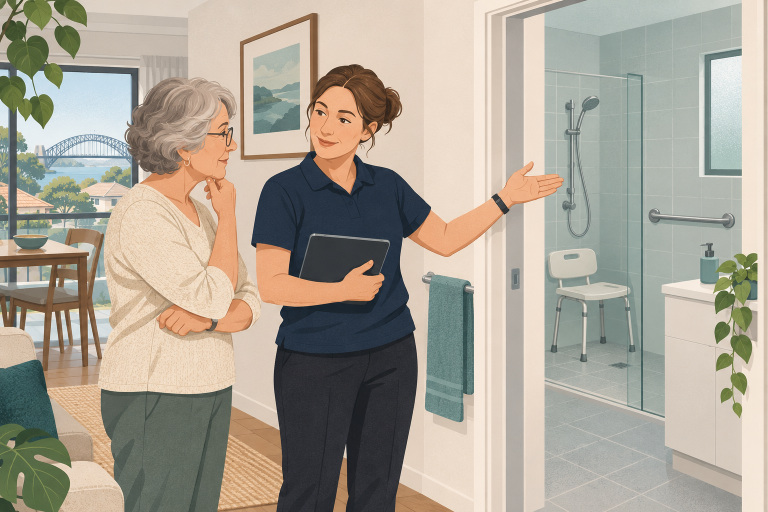

Is an NDIS participant finding it harder to walk around the house, get out of a chair or manage showering? The right referral depends on the activity that is difficult and what the participant wants to achieve.
Physiotherapy may be a useful starting point when movement, strength or balance is the main concern. Occupational therapy may be a useful starting point when the concern is managing everyday activities, equipment or the home environment. Some situations benefit from input from both. These are starting points for discussion, not a substitute for an individual assessment.
What is the difference between NDIS physiotherapy and occupational therapy?
A physiotherapist assesses movement and physical function. In home visits, this may include walking, balance, strength, transfers and a practical exercise or movement plan. Read about our NDIS physiotherapy home visits in Sydney.
An occupational therapist (OT) considers how a person manages the activities they need or want to do, including self-care and household tasks. Assessment may explore the person’s abilities, routines, support arrangements, equipment and environment. Our mobile occupational therapy service explains the types of requests we consider.
The professions overlap. The most suitable clinician depends on the participant’s goals, the assessment required and the clinician’s experience. A participant does not automatically need both services.
Which referral fits the situation?
| Everyday difficulty | Possible starting point | What to explain in the referral |
|---|---|---|
| Walking around the home has become harder | Physiotherapy for movement, strength and balance; OT input if access or daily tasks are also affected. | What has changed, usual walking aid, assistance needed and the participant’s mobility goal. |
| Getting out of a chair or moving between bed and chair is difficult | Physiotherapy for physical ability and transfer technique; OT for equipment and the setup of the activity where needed. | The transfer involved, current assistance and equipment, and any concerns raised by the participant or support team. |
| Showering, dressing or preparing meals requires more help | OT to assess the activity, routine, environment and possible strategies or equipment. | Which task is difficult, what help is currently provided and what the participant wants to do more independently. |
| Falls or near falls are affecting confidence at home | Physiotherapy for balance and mobility; OT if home layout or task-related barriers also need assessment. | When and where the events occur, relevant changes and existing mobility supports. |
| Existing equipment no longer suits the participant | An equipment assessment with a suitably experienced clinician, often an OT; physiotherapy input may be relevant for mobility aids. | The item, how it is used and what no longer works. Include any trial or reporting request. |
| The bathroom, entrance or other part of the home limits independence | OT to explore the activity and environment, including whether equipment or a home modification assessment is appropriate. | The access or task difficulty, current arrangements and the participant’s goal. |
Start with the problem rather than selecting a product or requesting a particular treatment. For example, “needs help getting off the toilet” gives the clinician a useful question to assess; it does not assume that a specific item is the answer.
If existing equipment no longer meets the participant’s needs, explore our OT equipment and assistive technology assessments in Sydney to understand the assessment, possible trials and reporting process.
When might both physiotherapy and OT be useful?
Consider input from both when there are distinct movement and daily living needs. For example, a participant may want to improve their ability to stand while also needing their shower setup assessed. Physiotherapy can assess the movement component, while OT can assess the activity and environment.
With appropriate consent, the clinicians can share relevant findings and agree who will address each goal. Clarify the scope, responsibilities and any liaison or reporting costs before work begins. Coordinating care should reduce unnecessary duplication, rather than add assessments without a clear purpose.
Following a hospital admission, share relevant discharge recommendations and clarify what ongoing disability-related support is being requested. New injuries, sudden deterioration or an acute medical concern may need medical assessment before routine therapy coordination.
Does the participant need a full functional capacity assessment?
A request for help with a particular activity or item of equipment does not automatically require a full functional capacity assessment. Explain the decision the assessment needs to inform and who needs the report. The clinician can then discuss whether a targeted assessment or a broader assessment is appropriate.
If a plan reassessment or other deadline is approaching, provide the date early. Confirm the proposed scope, estimated hours, fees and reporting timeframe before booking the work.
Check the NDIS plan before arranging services
The NDIS can fund eligible physiotherapy and occupational therapy supports where they meet its funding criteria. Check the participant’s actual plan, available funding and any stated support restrictions. Do not assume funding for one discipline can be used for another, or that a clinical recommendation guarantees approval.
The NDIS guidance on therapy supports explains the current requirements. Confirm any uncertainty about how the plan can be used before committing to services.
What should a support coordinator or family include in the referral?
- The participant’s suburb and preferred contact.
- The everyday activities that are difficult and the participant’s goals.
- What has changed, current assistance and relevant equipment.
- The requested assessment or service, if known.
- Funding management type, relevant plan information and any report deadline.
- Relevant clinical records, shared with consent or appropriate representative authorisation.
If you are unsure which discipline to request, describe the situation. Our team can seek clinical input to clarify the referral rather than asking you to make that decision alone. If an existing physiotherapy service is transferring, our provider handover checklist explains what to organise.
Arranging adult home visits with Bayside Mobile Physio
We provide adult physiotherapy and occupational therapy home visits across serviced Sydney suburbs for eligible self-managed and plan-managed NDIS participants. We confirm coverage, clinician suitability, availability, fees and service arrangements before booking.
You can describe needs for both disciplines in one referral. Each requested service is reviewed for suitability. A signed NDIS service agreement is required under our booking policy, and additional assessment or reporting work is scoped and approved before it begins.
Send a referral describing the participant’s everyday difficulties and goals. Include their suburb and funding management type so our team can review the request and discuss the next steps.