
Compare common OT assessments for Support at Home and NDIS clients. Learn when to request home safety, equipment, home modifications or an FCA.

Common occupational therapy (OT) assessments for Support at Home and NDIS participants include daily living, home safety, assistive technology, home modifications and functional capacity assessments. The best starting point is the problem the person wants help with and the decision the assessment needs to inform.
Which OT assessment should you request?
| What’s happening? | What to ask the OT to assess |
|---|---|
| Showering, dressing or preparing meals has become harder. | Daily living assessment. Ask how the person manages the task, what help they currently need and what changes could make the routine easier. |
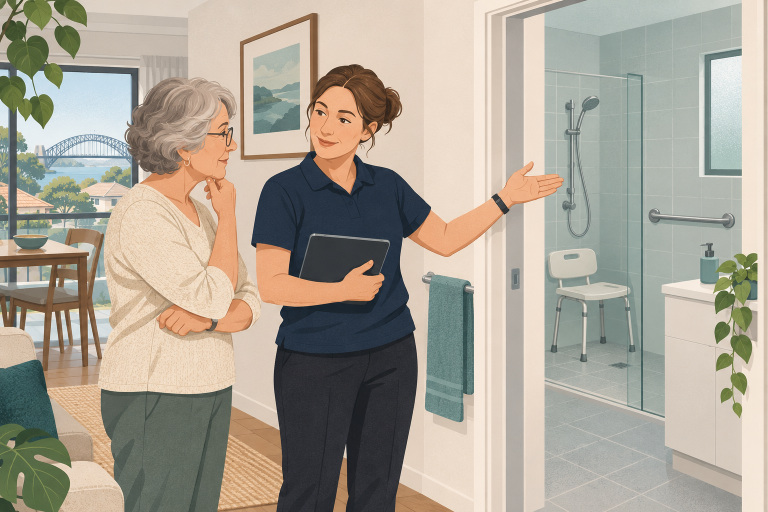
| The person has returned home from hospital and their family is concerned about getting around the house. | Home safety and accessibility assessment. Ask the OT to review the routes and tasks that are causing difficulty, such as getting to the bathroom or entering the home. |
| The person needs help getting on and off the toilet, or their existing equipment no longer suits them. | Assistive technology assessment. Ask whether equipment could help and whether a trial, fitting or training is needed. |
| A step, doorway or bathroom layout is limiting access. | Home modification assessment. Ask the OT to assess whether a change to the home would address the barrier. See our home modification assessments. |
| An NDIS participant needs evidence about how their disability affects daily life and the support they need across several activities or settings. | Functional capacity assessment (FCA). Ask what evidence is needed and how the report will be used. See our functional capacity assessments. |
What if more than one assessment seems to fit?
Describe the activity and where the difficulty occurs. For example, “Maria needs help getting into the shower because she has difficulty stepping over the shower hob.” That gives the OT a starting point to consider the bathroom layout, the way Maria completes the task and whether equipment or a modification could help.
The same approach works when memory or planning difficulties affect everyday routines. Explain which steps the person needs help with, such as starting a meal or finishing the steps involved in getting dressed. This can help the OT decide what to observe during a daily living assessment.
How do Support at Home and NDIS referrals differ?
Support at Home. Speak with the participant’s registered aged care provider about arranging a funded OT assessment. For equipment and home modifications, the provider can check the participant’s support plan and relevant approvals under the Assistive Technology and Home Modifications (AT-HM) scheme. See My Aged Care’s AT-HM guide.
NDIS. Explain the disability-related difficulty and what decision the assessment will inform. If a report is needed, include its purpose and any deadline. An FCA can provide evidence about how disability affects daily activities and help inform support decisions. Bayside Mobile Physio accepts OT enquiries for self-managed and plan-managed NDIS participants. See the NDIA’s guide to functional capacity assessments.
What to include in an OT referral
- The client’s suburb and funding arrangement.
- What has changed, which daily activities are affected and what the client wants to be able to do.
- What help or equipment they currently use, and any relevant prior assessments.
- The decision the assessment needs to inform, any report requirements and the deadline.
Our mobile occupational therapy team can review the referral and confirm assessment scope, fees and clinician availability before booking. Referring an adult with self-managed or plan-managed funding? See our NDIS occupational therapy home visits for booking and report requirements.